Yasmeen Jabri Built a Wellness Brand That Refuses to Stay Quiet
When violence escalated in Lebanon and Palestine in 2023, Yasmeen Jabri did something her advisors would have called a mistake. She posted about it.
She was one year into building Amphi Botanicals from her flat in London, and the conventional wisdom was clear: stay positive, stay on brand, keep politics off the feed. Every mentor she had spoken to said the same thing: a wellness brand has no business taking sides. She posted anyway, then went quiet on content altogether for a stretch, telling her community honestly that pushing marketing copy while people she loved were living through bombardment just did not feel right.
The customers who stayed became her most loyal. The ones who found her afterwards were exactly the ones she wanted.
Between Beirut and everywhere else
Yasmeen Jabri is Palestinian-Syrian, raised in Beirut, with family spread across the Levant and Gulf. She describes her upbringing as shaped by movement and collective life: your wellbeing is bound up with the people around you, without anyone needing to name it.
She had never planned to build a company. What she had always planned was to work in nutrition, specifically in medical nutrition therapy with cancer patients, until dietetics training in Beirut made that feel impossible. The clinical environment treated traditional plant knowledge as something to dismiss, and nutritional therapy as a lesser discipline, and Yasmeen found herself caught between two camps that she thought should have been talking to each other. “I was always kind of somewhere in the middle where obviously, I really value science and empirical evidence, but I also really like that there are plants that have been used for hundreds of years.” She felt, she says, like those spaces were really polarising.
That frustration followed her. In 2020, in the wake of the Beirut port explosion and with COVID-19 reshaping everything, she packed up and moved to London on a student visa to study entrepreneurship at UCL.
From ashwagandha to a business plan
The shift toward a business had started a little earlier, during travel in India with her mother. She encountered ashwagandha, started researching it, and connected that interest to her own experience with depressive disorder and with antidepressants that had not helped her. Here was a plant with centuries of use behind it, backed by a growing body of evidence, sitting largely outside the mainstream supplement aisle and largely ignored by the clinical world she had just left.
Back home, she had spent time working in pharmaceutical distribution, learning how products moved through markets and connecting with the CEO of Beesline, a natural skincare brand in Lebanon. She began experimenting with adaptogens and early product concepts, initially leaning towards skincare.
She brought it to a board of industry figures, people who knew the market well, and the response was blunt: go and learn about business first, and come back when you have. So she did exactly that. She enrolled in a master’s in entrepreneurship and did not look back. “This is gonna work, and I’m gonna find a way to make it work.”
Amphi Botanicals: science on one side, tradition on the other
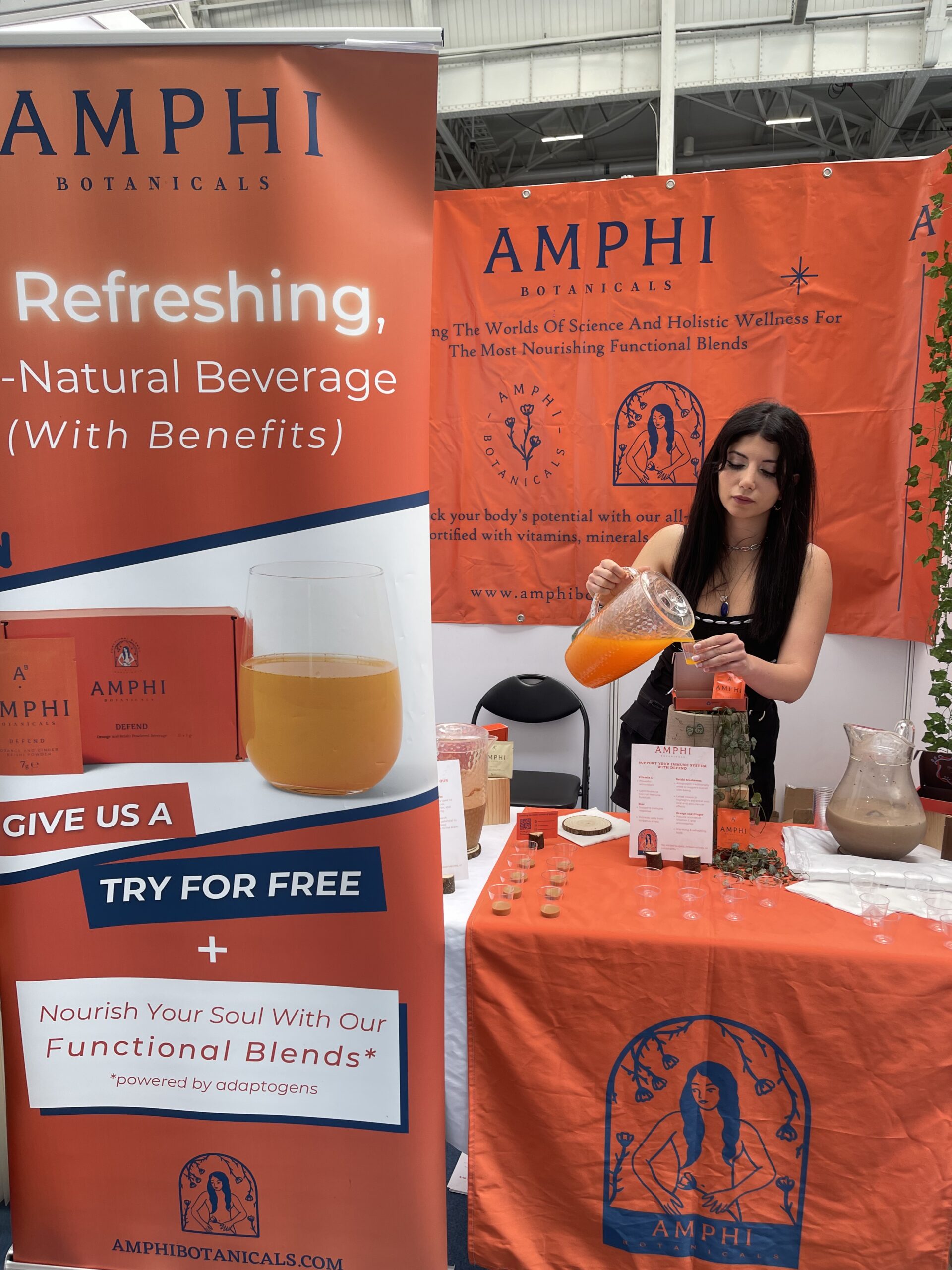
Amphi Botanicals was founded in 2022 and launched in late 2023. The name comes from the Greek prefix meaning “on both sides,” and that is the thesis in a word. Each blend combines vitamins and minerals with functional mushrooms and herbs, holding the frameworks of clinical nutrition and traditional plant medicine in the same formula rather than choosing between them. “I wanted to create something that really bridges that gap,” Yasmeen says. “Every blend has vitamins and minerals, which is the science side. And then the mushrooms and the herbs, which is the holistic wellness side.”
The products are manufactured in the UK, and Yasmeen receives the units and packs the boxes herself. The business has grown through organic traffic and word of mouth, slowly and deliberately. She is transitioning from single-serving sachets to 30-serving pouches for both cost and sustainability reasons, and one bestselling chocolate blend has been out of stock while she secures the funds to reformulate and relaunch it. That is the immediate priority, alongside getting the brand in front of more people through sampling campaigns and retail placement talks with the likes of Whole Foods and Planet Organic.
The cost of staying true
Yasmeen talks about the wellness industry with the precision of someone who studied it and then decided to argue with it. The dominant logic, she says, is self-optimisation: perform better, sleep deeper, focus harder, treat wellness as a personal project with measurable returns. What she experienced in Beirut during the crisis was something else entirely: people spontaneously organising, cleaning rubble together, checking on neighbours they had never spoken to before. Collective care as an instinct, not a brand positioning.
“There has to be a balance between caring for yourself and caring for other people around you,” she says, and that sentence became the brand’s operating principle.
It was also what made 2023 so difficult. She could have kept the brand separate from her views, as several advisors encouraged her to do, but she made a different calculation. Speaking openly, she found, filtered for exactly the kind of customer she wanted: the ones who stayed, who became subscribers, who told other people. “The more outspoken I was, the more I attracted people that resonated with the values of the brand.” Some distribution deals did not work out as a result, but what she built in their place was a customer base with real loyalty, which is harder to manufacture and worth considerably more over time.
She looked at companies like Ben & Jerry’s and Lush and saw a clear model: brands whose politics are baked in rather than bolted on, where the stance is precisely the reason people trust the product and keep buying it. The wellness market is crowded with interchangeable formulas and short retention windows. A brand with a genuine point of view is harder to copy. “I just wanna be true to myself and my beliefs, and I don’t want to compromise on my values.”
Further than the product
On the product side, Yasmeen is focused on growing the blend range and building deeper sourcing relationships with farmers in the Levant and beyond, including saffron from an Afghan farmer she is in early conversations with. The social ambitions reach further.
“The ultimate, ultimate, ultimate mission,” she says, is to create an impact pathway for skilled workers from Palestine, Syria, and Lebanon, through a UK sponsorship structure tied to the business. It is a vision, clearly stated and some way from implementation, but specific enough to point somewhere real, which is more than most mission statements manage.
Yasmeen is pitching at Forward·Inc Festival this year, part of her work with Forward·Inc’s Investor Readiness program. The business is early-stage and she says so plainly. What Amphi Botanicals is building, though, is something the wellness industry, for all its billions, has largely avoided: a brand that treats care as shared rather than individual, something you practise with the people around you, not on yourself alone.
That is a harder sell. There are people, it turns out, who have been waiting for exactly that.
Yasmeen is part of the Forward·Inc community and pitching at Forward Festival this year as part of the Investor Readiness programme. Curious about what Amphi Botanicals is building? View her investor proposition here.
Learn more about Amphi Botanicals and their functional wellness blends at amphibotanicals.com or connect with Yasmeen on LinkedIn.
Curious about how Forward·Inc supports newcomer entrepreneurs? Learn more at newcomersforward.com.