How Data Engineer, Tasnim Jemli, Is Bringing Tunisian Heritage to Dutch Tables
Tasnim Jemli resigned from her job in December 2023. A week or two later, she found out she was pregnant. Most people would have called it the worst possible timing. She calls it part of the journey.
That response tells you something important about how Tasnim operates. She chooses alignment over safety — between her work, her health, her values, and the life she wants to build. And when those things finally lined up, she moved.
The career that no longer fit
For nearly five years, Tasnim worked as a data engineer in the Netherlands. She had moved from Tunisia on an AIESEC internship and built a solid technical career, eventually working with companies including FedEx and Irdeto. On paper, it was working. She was competent, comfortable, and respected.
But comfort and fulfilment are different things entirely. When conversations came up about development plans and progression, she noticed something: she had no real ambition to advance further within that world. What she wanted was to build something of her own, something rooted in a purpose she could feel rather than a promotion she could chase.
That instinct had been present since university. What changed was that entrepreneurship stopped being an abstract mode of working and became attached to something deeply personal: her health.
The transformation that changed direction
For years, Tasnim had followed mainstream advice about weight and well-being without meaningful results. That frustration pushed her into a much deeper inquiry. Whilst still working full-time, she studied seriously enough to become a certified health coach. She changed how she ate, how she moved, and how she understood her body. For the first time in her life, she reached what she described as her ideal weight, and noticed wide improvements in her energy, focus, and clarity along the way.
The transformation reached further than the physical. Living far from Tunisia, away from family and the familiar rhythms of home, she found herself asking bigger questions: why she was here, what she was doing, and how she wanted to live. That period of solitude and self-inquiry was difficult, and also formative. It led her to share what she was learning, first quietly, then more publicly. Women began reaching out for advice, and a community began to form around conversations on health, self-growth, and living better.
She organised workshops, retreats, and events. At those retreats, she gave out bottles of olive oil as gifts, using a label she had created herself. It was the earliest expression of something she had not yet named.
Gold that nobody branded
Tasnim’s family owns an olive farm in Tunisia, started by her grandfather and continued by her father and uncles. Growing up, it felt ordinary. Tunisia has olive trees everywhere, and that familiarity made it easy to take for granted.
What changed was her perspective. Once she started learning seriously about health and food systems, she saw what she had grown up surrounded by in an entirely new light. Tunisia is the world’s second-largest olive oil producer and the leading producer of organic olive oil. She describes it as gold that her country had not yet learned to brand. For decades, much of Tunisia’s harvest was sold in bulk to European processors who bottled and labelled it under their own names, capturing the margin and the story that should have belonged to the source.
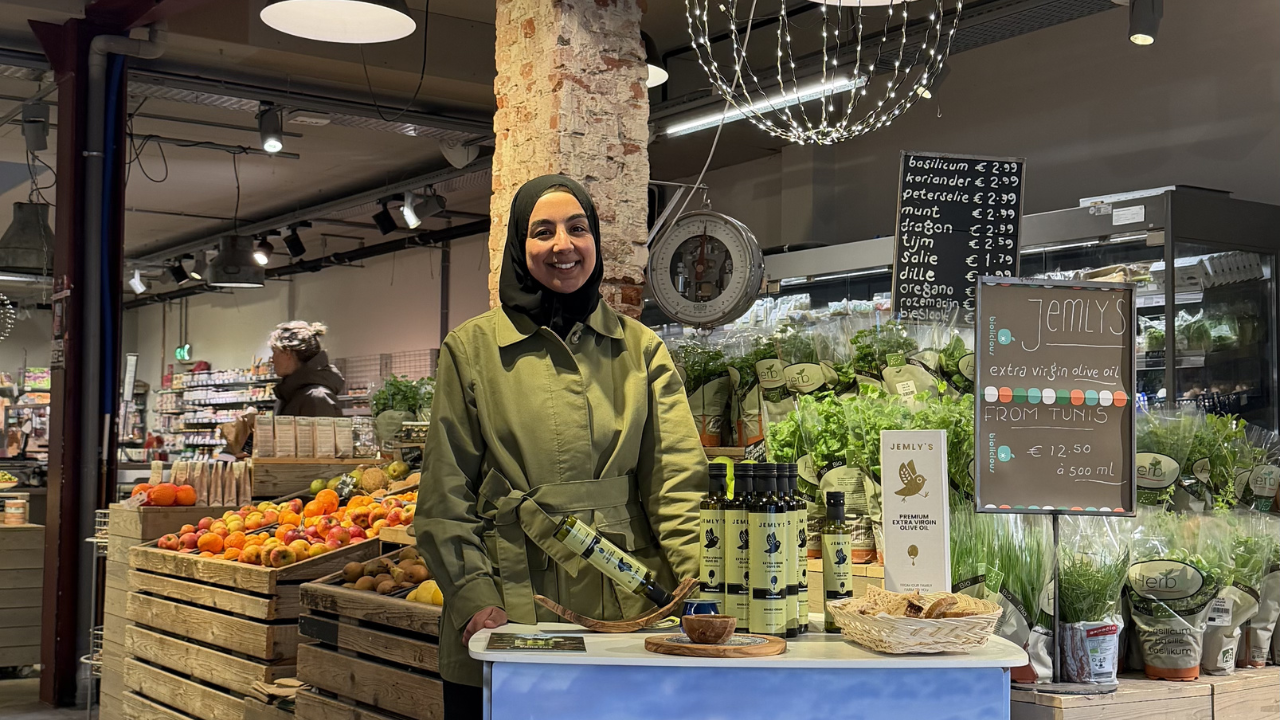
That gap, between the quality of what Tunisia produces and the recognition it receives internationally, became her market insight. Jemly’s, her extra virgin olive oil brand, sources single-origin, cold-pressed, hand-harvested oil directly from her family’s groves and brings it to the Dutch and German market under a Tunisian name, with a Tunisian story at its centre. The product that once left Tunisia without identity now arrives with one.
The brand goes well beyond a family agricultural product dressed up for export. Tasnim has professionalised the entire chain. She completed sommelier courses, learned the technical side of quality assessment, and now oversees production with exacting standards and market knowledge that she brought back to the farm herself. She returned home as someone transforming what the land could become, carrying branding, rigour, and a clear sense of who the customer is.
Selling in a market built for others
Building the business has been harder than the idea. Tasnim says it plainly: the biggest challenge is sales. She has sent over a thousand emails to retailers. Most went unanswered. Rather than pulling back, she layered her approach: emails, LinkedIn messages, calls, samples, visits, and sustained in-person presence. One Amsterdam wholesaler repeatedly declined to stock her product, then reached out months later simply to say they had noticed her appearing elsewhere and seen that she was gaining ground.
She took that as proof that persistence creates visibility, and visibility eventually creates opportunity. Structural headwinds make the persistence necessary. Olive oil imported from outside Europe carries an additional tariff of €1.45 per kilogram, and the quota mechanisms that reduce this primarily benefit large bulk importers. Jemly’s competes at a disadvantage against entrenched brands with decades of shelf presence and institutional backing. So she competes on other terms: story, origin, quality, and showing up consistently until the right doors open.
Her current retail partners include Biolicious and Ekodis Natuurmarkt in Amsterdam. She runs olive oil tasting workshops, food pairing events, and corporate gifting campaigns. The business is real and growing, even if profitability is still a work in progress.
The messy middle, documented
Alongside the outreach and the market visits, Tasnim publishes a weekly newsletter called The Olive Oil Diaries, now read by over 700 subscribers. She posts regularly on social media. She is running a 115-day public accountability challenge, sharing the process of building Jemly’s while she is still inside it, before the outcome is clear.
This is building in public, and for Tasnim it is deliberate, uncomfortable, and necessary. Her logic is direct: visibility creates credibility, and credibility, over time, creates sales. She treats public content as one of the few tools she can actively control whilst working to grow a business with limited resources. Staying visible is part of the strategy.
But she finds it hard. Content creation drains her. She has been on and off with it, pulled between the time it takes and the momentum it builds. She struggles with the emotional weight of it: comparing herself to other founders, watching posts land differently than expected, feeling the pull of what performs well on an algorithm versus what feels genuinely useful to share. And underneath all of it sits a persistent tension. She sometimes wonders what gives her the right to speak publicly when the business has not yet fully proved itself.
That tension is precisely what makes her version of building in public worth paying attention to. She is posting from a position of becoming, not arrival. She is trying to speak whilst still uncertain, still selling, still proving the business can work. The retailer who noticed her persistent outreach and growing presence before ever stocking her product made her believe the approach was right, even when the numbers were slow to follow.
What success looks like now
Her father recently asked her how long she had been at this, and whether she should reconsider. She understood the question. She also kept going.
For Tasnim, the measure of the journey is partly financial and partly something harder to quantify: whether the life she is building feels like hers. Health, faith, motherhood, heritage, and business are, in her view, one connected system. When they align, everything works better. Jemly’s is the clearest expression so far of that larger pursuit.
The decision to leave employment crystallised partly through a conversation with her mentor who told her to trust herself and trust she would find her way toward what she was meant to build. That framing gave the leap a dimension beyond career calculation. It made the risk feel purposeful.
Right now, success means one concrete thing: more sales. More sales create more cash, more capacity, more growth, and eventually a business that can sustain the vision she has carried since those early retreats, when she handed out bottles of family olive oil as gifts and thought little of it.
Tasnim is part of the Forward·Inc community. Learn more about Jemly’s and their single-origin Tunisian extra virgin olive oil at jemlyshealth.com or connect with Tasnim on LinkedIn.Curious about how Forward·Inc supports newcomer entrepreneurs? Learn more at newcomersforward.com .