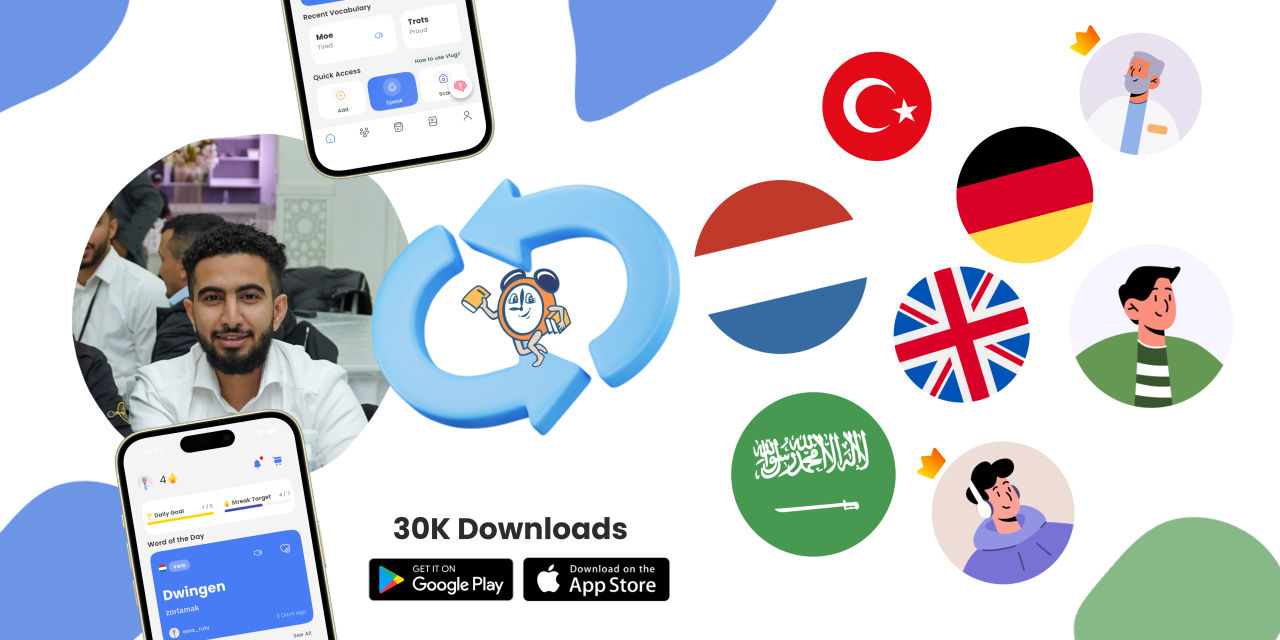
Bashar Alshaibani Kept Forgetting Dutch Words. So He Built the App That Fixed It.
Bashar Alshaibani arrived in the Netherlands in 2022 with a problem that will be familiar to anyone who has moved countries: he kept forgetting words. He had notebooks. He had Duolingo. He had vocabulary lists and genuine effort, and Dutch still slipped away from him.
Most people try harder with the tools they have. Bashar took a three-week break and built a new one. “What I have? Oh, I have this problem. Let’s solve it.” That is how Vlug, a vocabulary retention app that lets users build and rehearse the words they personally need in daily life, came into existence.
Yemen, Malaysia, and a decade of building instincts
Bashar was born in Yemen and spent most of his formative years in Malaysia, where his father had relocated for a PhD in biomedical science. He studied IT there, and it was during that period that the instinct to build products took hold. He describes watching platforms like Instagram and feeling something specific: not just admiration, but the desire to make something that other people would use every day. “I always wanted to have programming companies.”
In 2022, after COVID-era changes at Malaysian universities made the situation less stable for international staff, the family moved to the Netherlands. The transition was the kind that demands everything at once: new language, new job market, new social context, all in parallel. Bashar was already carrying the habit of building. The move gave him the material.
From frustration to first users in three weeks
The frustration with existing language tools was precise. Duolingo and similar platforms push learners through preset vocabulary paths: words chosen by the app, in sequences designed by the app, at a pace set by the app. Bashar found that the words he was being taught often had no connection to the words he actually needed. The Dutch he encountered at work, on forms, in shops, none of that appeared in the lessons. He was learning a language in the abstract while his daily life required something more immediate.
The first version of Vlug, built over three weeks entirely by Bashar, was a direct answer to that gap: a tool for storing, reviewing, and rehearsing your own vocabulary, the words that come from your actual life. He shared it with classmates. They asked for more features. He kept building. “People are struggling with the same problem. Let’s improve it.” That cycle, real need, early users, iterate, has been the company’s operating logic from the beginning.
The cost was real. For months he was handling everything himself: coding, server management, AI integration, bug fixes, customer support, social media, and marketing. He describes losing sleep, withdrawing from people, skipping exercise. “For the past four months, I couldn’t sleep. Every time I go to bed, I get a new idea.” He kept going. He also, eventually, started using project management tools and learning to pace himself, because he had to.
Vlug: your vocabulary, not someone else’s
Vlug now serves more than 20,000 users across 18 languages, with learners adding words from their daily life and reinforcing them through games and AI-assisted review. The app’s differentiator is its premise: rather than assigning vocabulary, it helps users capture and retain the words they already know they need. For a newcomer preparing for a Dutch language exam, a professional picking up a third language for work, or a student trying to hold onto vocabulary between classes, the tool is built around their context rather than a generic curriculum.
When operating costs climbed as usage grew, Bashar took a role at Philips, working on a cancer tissue scanning project, as a financial support structure for the business. The day job runs from nine to five. Vlug runs from five until midnight. He is straightforward about the arrangement and equally straightforward about what it is for: he wants the resources to invest in user acquisition, because he has already seen that well-made educational content can spread, and he wants to scale that. “The core ideas of the app are built on my own struggles.” The next chapter is about turning that foundation into something durable.
Building for the person who needed it
Bashar is not a founder who talks about disruption or market size. He talks about users who messaged him to say the app helped them pass a writing exam. He talks about people who were struggling the same way he was and found something that worked. His product instincts are shaped less by investor feedback than by the signals users send him through their behaviour: if people ask for a feature, he experiments; if growth slows, he switches into marketing mode; if something is not being used, he asks why.
There were harder moments, too. Competitors contacted him with legal threats, claiming he had copied ideas they had discussed. He briefly took the app down before being encouraged to relaunch. The episode was unsettling, and he is candid about that, but he did not stay down. He put everything he knew back into the product and kept building.
What drives him is something he comes back to in different ways across the conversation: the feeling of having solved a problem that was genuinely yours, and then watching someone else solve the same problem with the thing you built. “You have, like, solved a problem.” For Bashar, that is the point. The rest follows.
Bashar is part of Forward·Inc’s Investor Readiness programme and will be pitching at Forward Festival this year. Vlug is early-stage and growing, built by someone who moved countries, felt the problem in his own life, and built the solution in three weeks. He has been building since.
Bashar is part of the Forward·Inc community and pitching at Forward Festival this year as part of the Investor Readiness programme. Curious about what Vlug is building? View his investor proposition here.
Learn more about Vlug and their personal vocabulary retention app at vlugapp.com or connect with Bashar on LinkedIn.
Curious about how Forward·Inc supports newcomer entrepreneurs? Learn more at newcomersforward.com.