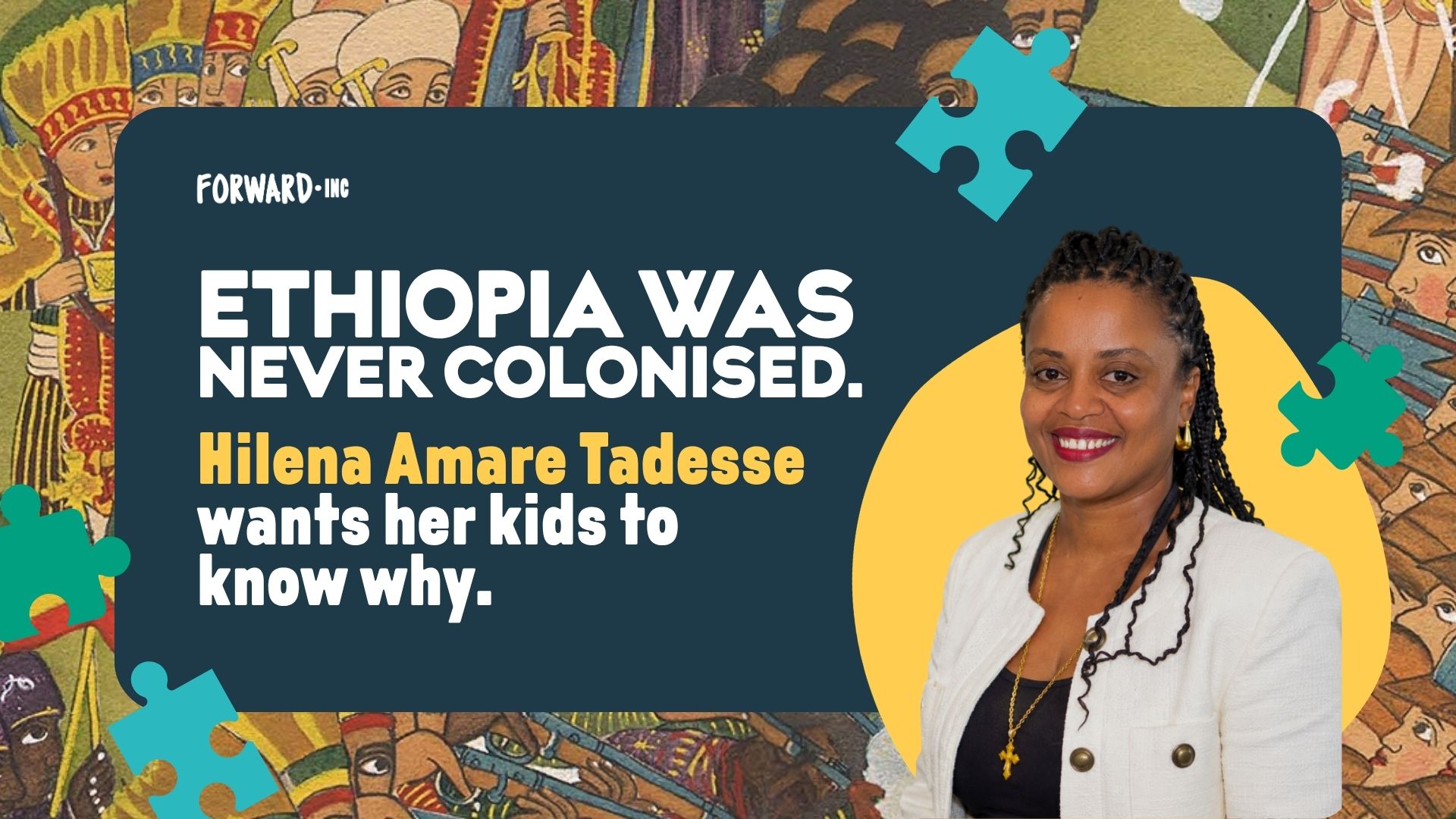
Ethiopia Was Never Colonised. Hilena Amare Tadesse Wants Her Kids to Know Why
Hilena Amare Tadesse spent years measuring other people’s programs. As a Monitoring, Evaluation, Accountability and Learning specialist, her job was tracking whether interventions worked and writing up the evidence. Then she moved to Amsterdam, had children, and ran into a problem no evaluation framework could solve: there was nothing to play with that taught her kids where they came from. So she built one herself, in the shape of a puzzle.
A mentality built for employment, not entrepreneurship
Growing up in Addis Ababa, her path was already decided: study, then work, then a better job than the last. She followed that ladder through a bachelor’s degree in history, a master’s in Management of Development from a Dutch university, and years of project coordination across Ethiopian NGOs.
Moving to the Netherlands rewrote the terms of that ladder. A new language, culture, and a job market that read her CV like it had been written in a dialect it didn’t quite trust. She freelanced when there was work and volunteered when she could. After some years in the Netherlands, she signed up to join Forward·Inc’s Digital Entrepreneurship Program, all the while freelancing she made it work.
That program is where something shifted. She says, “I can be my own boss,” she remembers thinking, as though the idea had been waiting for permission. She had always assumed she would try entrepreneurship eventually, later. The program asked a simpler question instead: why wait that long?
From idea to prototype
Every so often, Hilena’s children ask her about Ethiopia, about where the family comes from, and she answers the way parents do: with a story, told at the kitchen table, in whatever Amharic they’ll sit still for. She struggles to do it well without preparation, and often finds herself improvising. When she talked to other diaspora parents, they described the same problem back to her, almost word for word: everyone relied on memory and the odd search online, because no one had built anything specifically to teach kids this history. That repetition convinced her to build something herself, a set of educational puzzles designed to teach Ethiopian history and culture to children growing up far from it.
She signed up for the Forward Incubator to find out what parents like her actually wanted and how to turn that into something real. The program gave her idea a deadline. She went full-time, built her own small team, and had a working prototype within five and a half months. She had assumed a book would do the job. The families she tested it with said otherwise: nothing like it existed for Ethiopian history, and their kids would actually pick up a puzzle, not a book. It was a small pivot on paper, but it reshaped everything that followed, right down to which story the puzzle would end up telling.
Choosing a battle, carefully
Her first instinct was Lalibela, the rock-hewn churches that had shaped her own history degree. The families she surveyed pointed her elsewhere, toward the Battle of Adwa, the 1896 victory that made Ethiopia the only African nation never colonised. Telling that story to a six-year-old meant choosing resistance as the point, and leaving the blood, the muskets, and the casualty count out of it. In the battle, a queen acted, and a king acted alongside her, and together Ethiopia fought off a colonial invasion and stayed free. That is the version a child can carry. Scan the finished puzzle and a short audio story plays, built around that idea alone.
She tested two versions, one hand-illustrated, one AI-generated. The children sorting between them turned out to be sharper critics than she expected. They spotted the difference immediately, calling the illustrated version “actual” and noting that the AI one, however colourful, gave itself away. The preference still split cleanly by age. Made for children six and up, the illustrated version was the one older kids reached for. Afterward, they could retell Adwa’s history in their own words, more clearly than before playing. The AI version, full of butterflies and birds and colour, won over the four-and-up crowd instead. What stayed with Hilena was watching six- and seven-year-olds hand her back the whole story, takeaway included, minutes after finishing the puzzle.
What still needs to change
Hilena hasn’t stopped at her own community’s history. Most toy shops sell dolls, books, and games built around one kind of child, white, by default, and if a Black or brown doll exists at all, it tends to stand alone on a shelf full of everyone else. She wants that changed for every community raising children far from home, her own included.
She is equally open about what people sometimes misunderstand about her journey. Hilena describes herself as resilient, someone who has learned to adapt wherever life takes her. People often assume that moving to Europe made things easier for her by default. What she’d tell you instead is that whatever ease exists now, she built herself, day by day. For her, resilience has meant learning, every day, how to navigate unfamiliar systems, understand new expectations, and find her own voice in a different environment. She learned that opportunities here wait to be sought out: you introduce yourself, speak up, build connections, and create your own path. Learning to advocate for herself, as she puts it, became its own kind of relocation.
The puzzle piece still missing
Having a working prototype is one thing. Turning it into a product people can actually buy is another, and that’s the stage Hilena is in now. She’s chasing manufacturers, working through EU regulations, and building a website in whatever hours she has left. A pre-order push at the last Forward Festival covered roughly five percent of what a first production run will cost, and another is planned. Funding remains the real challenge, and access to finance and credit support is a tough wall to break through.
Her goal for the next year is modest on paper, ambitious in practice: sell at least a thousand puzzles, distributed through Ethiopian communities in the Netherlands, Belgium, France, Germany, and Italy, the places where families are already asking for what she’s building.
Behind that number is the reason she’s chasing it in the first place. Hilena wants Ethiopian stories, history, culture, and identity woven into children’s everyday lives through play, something they pick up while having fun. The puzzles, and whatever she builds after them, are meant to let children discover Ethiopia piece by piece, while giving parents a meaningful way to share their heritage with their children.
Hilena is part of the Forward·Inc community. Follow her Ethiopian history puzzle project as it develops, or connect with her on LinkedIn.